May 15, 2013

Midnight in Paris


*spoilers*

I have a love and hate relationship with Woody Allen.

So much so that I only watched Midnight in Paris because it was being played at my gym. The movie was so interesting that I ended up working out for much longer that I wanted to.

Midnight in Paris is about a young Hollywood writer, Gil, who is inexplicably transported to 1920’s Paris every night. There he gets a chance to enjoy the company of Hemingway, Dali and Bunuel – all extremely creative people unlike the snooze that are his fiancĂ© and friends in the present.

While none of the characters understands Gil’s nostalgia, the movie supposes the audience does.

I, for one, am normally very pessimistic about the present and being in a gym where everybody (including myself) is spending lots of money, time and energy on losing weight through moronic exercises probably enhanced the feeling that we are all in pretty bad shape.

Don’t expect a great conclusion to Gil’s dilemma though.

Between a barren, boring present and an electrifying past he will compromise. The only problem with that is that is a bit conformist and not original.  Conformist because there is a big difference between dreaming of living in the past and looking at your present critically. Not original because how many recent movies end with the message: “be happy in the present, follow your dreams, don’t sell out and find a quirky girl who loves you for who you are”? Of the top of my head I can think of Stranger than Fiction, Little Miss Sunshine and Ruby Sparks.

What’s strange is how Gil came to terms with the present. It's only because he discovers everybody is nostalgic and unhappy with their present - whatever that time that is.

It's what Woody Allen puts in the mouth of one of his characters "The present is unsatisfying because life is”.

It's as if life would be awful no matter what time period you live in, which is a little tricky. 

On one hand, people that are nihilists like Allen would definitely be unsatisfied with the present no matter when they lived in (just like people that find a purpose in life manage to live well in any era). 

On the other, it's not like all time periods have the same advantages or disadvantages. Living in one period is not the same as living in another, as any grandpa can tell you.

I wonder if deep down Allen believes Gil will be happy. 

I'd say, based on his other movies, that he thinks Gil should be happy his life is not totally horrible. But I guess anyone who thinks life is that unsatisfying cannot be happy for long.

What did you think of Midnight in Paris? What time would you like to live in? (I'm highly favorable to the 1920's myself)

May 09, 2013

Reading in trains


Sorry everyone for leaving the blog a bit abandoned. I was half busy, half out of town and half without ideas.

Speaking about traveling, I had a very difficult decision to make on my last trip - what book to read on the train.

It might seem a banal decision but it’s one I take seriously. Even though technology helps passing the time while on a train or an airplane, you can’t trust technology or an airline taste in movies.

I learned my lesson when on my last plane ride I watched School of Rock (for the tenth time) and ended up hating it for good.

It’s just like that “what book would you take to a desert island” game. In both scenarios you are stuck in a place with nowhere to go, nothing to distract you and a cannibal sitting next to you. 

So before boarding any type of vehicle that requires the use of the verb ‘board”, I think about the book I’ll read. The most practical choice is the book I’m reading at the moment. 

I wish it were that simple.

I was reading the library’s copy of Shakespeare's Romeo and Juliet and I wouldn't risk something happening to it. I know from experience that losing the book is not the worst that can happen to it. I once had to buy my college’s library another copy of Paul Auster’s The New York trilogy because my dog peed on it. In his defense it was on the floor and in my defense I didn’t keep the peed book to myself.

Another issue is weight. Art through the ages is too heavy and C. S. Lewis' The Abolition of Man is too light.

The subject of the book is something else to consider. Many people read in trains so that no one will bother them, but the thing is: you don’t want to talk to a strange stranger.

If you have a strange stranger sitting next to you, you just want to bury your head in a book and give the impression you are a medieval scholar. But if you have a tall dark stranger type sitting next to you, I bet you’d be kicking yourself for not being the type of girl who packs lipsticks instead of books.

So a trip book must be multi-action: interesting and not embarrassing.

At last, I took Shadowplay, a non-fiction book about the works of Shakespeare.

It’s the book I’m reading at the moment, it’s medium size, neither embarrassing nor a conversation killer. It’s also mine so if anything happened to it, I wouldn’t look like a careless punk in the librarian’s eyes.

What books do you read when you travel? 

Image via National Railway Museum

April 17, 2013

My museum purse


I love going to museums and while I was visiting the National Gallery in Washington the other day I realized how important it is to have a light bag filled with everything you need to enjoy your museum trip.

Here what I usually take with me:

Museum purse

1) Small notepad and pen. 
Once I had to ask the security guard for a pen and wrote notes about the art works in my hands. Another time I had to come back to the museum to copy the name of an interesting book that was quoted in one of the explanation boards. After this I learned to always carry a pen and a small pad – everywhere, as a matter of fact.

2) Cash
Sometimes the audio files' booth doesn’t accept credit or even debit cards, so it’s good to have some extra money for this.

3) Camera
I used to be a little skeptical about this and never took a camera with me. I guess it's optional, but cellphone cameras are pretty light. 

4 and 5) Water and a little snack. 
I always take an inexpensive water bottle because some museums don’t allow water so you might have to leave your water in the entrance. Also most museums don’t allow food, but you can sneak in a cereal bar or some fruit.

6) Strap bag
Comfort is key. Strap bags allow your hands to be free and you can't put too much extra stuff in them.
  
What do you take with you in a museum trip?

April 10, 2013

Eastwood for Easter: Gran Torino


I’ll be honest: I’m not a big Clint Eastwood fan.

I stay clear of any type of western, no matter how much they try to lure me by associating themselves with spaghetti. Growing up, I have a faint memory of watching a movie with Eastwood and either Johnny Deep or Christian Slater, can’t remember which. His last movies were simply painful to watch and too disturbing for a second watch.

I couldn’t even finish watching Bridges of Madison County.

Gran Torino, on the other hand, is a completely different case.

Eastwood is Walt Kowalski, an intolerant old man who, after his wife's death, has to deal with his estranged family, an insistent priest and too many immigrants in his neighborhood.

Walt is alone and feeling completely alienated from his environment. As a Korean war veteran and a long time worker of a Ford factory, he doesn’t fit in a world of ethnic gangs and cocky teenagers.

Things start to change when his neighbor Thao tries to steal his coveted, vintage Gran Torino. Under Walt’s wings, Thao, also alienated from his surroundings, will learn how to be a straight up guy.

Many people don’t like this movie because Eastwood’s character is just so politically incorrect. But there's more to the movie than Walt's rants. At times, the movie is very funny, like in the scene where Walt and his barber teach Thao how to talk like a man. There are also very moving dialogues, such as the one when, replying to a man talking in a foreign language, Walt approvingly says: “You said it, brother.” 

Following the general tone of his latest movies, Gran Torino has some strong scenes, but it is a much easier watch than Changeling or Mystic River.

And whether we like it or not, Walt is one of the most interesting things about Gran Torino. He is this crazy 80 year old Dirty Harry - who will totally surprise you in the end.

For last year's Easter I talked about the film The Passion of the Christ and this year I chose Gran Torino. It deals with very real human dramas and several modern problems but presents an utterly Christian solution to them. 

Who knew a Clint Eastwood movie would be such a fitting option for Easter?  

Have you seen Gran Torino? What do you think about Clint Eastwood movies?

March 27, 2013

On the highway to hell: The Screwtape Letters by C. S. Lewis

Just one of the many amazing quotes from Lewis' book, The Screwtape Letters 

I recently finished reading The Screwtape Letters, a book by C. S. Lewis comprised of humorous letters written by an experienced demon to his nephew – also a demon.

Screwtape, the author of the letters, gives out advice to Wormwood, his nephew, on how to better tempt his "patient", a man recently converted to Christianity.

It’s a very short book, but also very unusual. The way Screwtape talks is the opposite of ours. What he calls "the Enemy" is God and when he says "our father" he means Satan. Through this inverted worldview, the reader gets something like a secret insiders view on the devil's tricks and plans.

What I liked best about the book is how it shows that the devil acts primarily on the human intellect. Less like what we see in horror movies and more like what we see in cartoons.


Be prepared: the book is most times very funny, but it get very scary pretty fast. The fate of the two demons and of the damned souls is horrifying. And with each letter we see a description of the seemingly unimportant, day to day dramas of our very own lives. I doubt anyone can read the letters and not find the situations described in them familiar.

Who knew that the author of the wonderful children's saga, Narnia, would write something this complex, funny, eye opening and easy to read?

I’m off to read the rest of Lewis’ work. Partly because I'm so impressed by his writing and partly because I don’t have the guts to listen to Andy Serkis reading the letters.


Have you read The Screwtape Letters or other books by C. S. Lewis?

Image via The Antelope and still from Disney's The Emperor's New Groove

March 21, 2013

The Taking of Christ by Caravaggio


A little bit of history

Date: 1602
Located in the National Gallery of Ireland, Dublin.

Caravaggio’s painting is a vivid portrait of one of the first scenes of Christ’s Passion. It depicts the moment when Judas betrays Jesus by pointing Him out to the Pharisees’ soldiers with a kiss.
 
Saint John (the figure on the left) runs away from the scene in utter fright. Christ is motionless, sad but dignified, in the middle of an agitated, moving crowd.

This painting has a rather funny story. 

Everybody thought it was lost. 

It had actually been with the Jesuit priests in Dublin - in their dining room! - for over 60 years. They didn't have the slightest clue that it was a real Caravaggio. 

It was only discovered and recognized when the priests called a specialist from Dublin’s National Gallery to look at other paintings they had.


A little bit of technique
What attracts people to Caravaggio’s paintings is at the same time what’s make people dismiss them: his realism awes and repels. It puts us right into a scene and then makes it unbearable.

It is as if, at any moment, the crowd will proceed to our left, taking Christ away, and in a fleeting moment the canvas will be empty.

I understand the complaints that Caravaggio can lose sight of the sacred sometimes but I don't think this happens in this painting.

I like the proximity between the guard’s cruel hand in Christ’s throat, which anticipates all the brutality and violence of the Passion, and Judas’ lips, which in a gesture of love and friendship betray and deceive.

The shiny black armors also call my attention, looking strangely modern and menacing.


A little bit of enthusiasm
Easter is fast approaching and art offers so much material for meditation. This painting in particular is no exception.

For starters, it is said that the men on the right is a self-portrait of Caravaggio. Why paint himself on the scene where Christ is captured? It reminds me of Mel Gibson who is the hand that nails Christ to his Cross.

It’s no secret that despite his highly spiritual paintings, Caravaggio was a wretched bar brawler, dying at the age of 38 under mysterious circumstances. Everybody is surprised at this, but how can a man who paints with such vigor, drama and emotion not be a brawler?

And that's just the thing: our hearts are just as inconstant and paradoxical as Caravaggio’s life. They are a battle ground where we can easily lose perspective on everything. 

Look at Saint John running away. He was the disciple Jesus loved the most.

This is why I like Caravaggio’s paintings. They pull me closer. Sort of an antidote to indifference towards Christ's suffering.

Caravaggio grabs us by the collar, puts us right next to him and acts as a wakeup call, urging for a mindset proper for Easter

What do you think about Caravaggio's realistic style?

Image via Wikipedia

March 13, 2013

1 year anniversary speech

Yesterday my little blog turned one! 

I might be exaggerating, but I think that calls for a celebration. So, as you read, imagine I’m spraying you with champagne, the way those pilots do after they win a Formula 1 race.

This could be the imaginary champagne talking, but I want to thank everybody for reading and supporting the blog. Your comments make my day and I’m thrilled to find other people that share my passion for culture.

***

You know, in January I was reading this article about a New Year’s detox diet

I used to be a big fan of detox diets. Just like the Cat Woman in that disapointing Batman movie, I would really like to clean the slate: she committed one too many crimes, I ate one too many ice cream sandwiches.

So, I decided to go on the New Year’s detox diet. I bought everything: kale, collard greens, apples, bananas, parsley... And that was all for one smoothie.

When I was almost dying drinking that, it hit me.

This diet takes a gigantic amount of will power and energy. And what for? Wouldn’t it be much more rewarding to go to all that trouble to detox my mind? I’m the Culture Enthusiast, after all. I ought to go on a cultural detox too.

And so I did.


My cultural diet, just like my regular diet of potato chips and coke, was unhealthy. I knew I had hit rock bottom when I memorized a Justin Bieber song (show you off…).


In my defense, I didn’t memorize it on purpose. It’s just that I listened to it over and over in stores, at the gym and pretty much everywhere. But still... Justing Bieber didn’t put a gun to my head and made me watch reality shows. I was the one spending hours consuming mind numbing, brain cell killing cultural material.

So, I got back on track. I picked up the dusty copy of Guy the Maupassant’s short stories. Did a little research on classical music and finally discovered the name of a composer I long loved. Revisited some of my childhood favorite movies.

In the beginning it took a lot of effort, but it was worth it. Much more worth it than drinking kale. 

Because it's much easier to go back to a healthy diet than it is going back to a healthy cultural diet. I don't want to sound drastic, but once you get used to a diet of cultural junk, there’s no telling you’ll ever come back.

I’m laughing right now, but it's dangerous exposing yourself to certain things inadvertently. 

The other day I saw that actress from Harry Potter saying she was watching a lot of reality shows to prepare for a movie.


She said:  "I was doing an English course [at Brown University]. So I would go from reading Virginia Woolf to [watching] Kim Kardashian. I kind of loved it, this mix of super-high and super-low culture. I think it was a nice balance." 


While I can totally relate to what's she is saying, I don't think it's a "nice balance", I think it’s risky business. It's not like math, where you can mix a high number with a low number and get an average number.


I see it as Kim Kardarshian pulling you from one end and Virginia Woolf from the other, as if they were participants of a Tug of War game where you are the rope and the prize is your mind.

Since it takes much less effort to go to Kim’s side, you might find yourself one day spending hours and hours with Kim and never wanting to visit Virginia ever again.

As they say, a mind’s is a terrible thing to waste. Cultivating good cultural habits involves effort, but it’s what feeds your intelligence and soul.

And that’s why I like writing for this blog. It's when I remember I have to educate myself because no one is going to that for me. It's an extra motivation to turn off the Tv and open a book. It's an encouragement to think and talk about things that I like and that really, really matter. Unlike my New Year’s detox diet.


Thanks again for bearing with me and here's to another year!

March 06, 2013

Witness for the Prosecution


Shala from Life Between Films hosted a "London in Genres" blogathon, where several people recommended movies that are about or set in London. There's one movie for each genre and the full list has amazing recommendations.

Here's mine, about the movie Witness for the Prosecution in the Classics genre:

Witness for the Prosecution pays homage to two British institutions: London’s Central Criminal Courts, a.k,a the Old Bailey, and Agatha Christie.

Based on one of her plays, Witness for the Prosecution is a mystery classic directed by Billy Wilder, but many people think it was directed by Alfred Hitchcock (a pretty neat compliment for a suspense movie, wouldn’t you say?)

Sir Wilfrid (Charles Laughton) is a London barrister defending Leonard Vole (Tyrone Power), an American veteran accused of murder.

Not much more can be said without spoiling the movie. When it was first screened, movie goers had to sign a written statement saying "I solemnly swear I will not reveal the ending of Witness for the Prosecution." 

Just like in a theater play, most of the movie’s action happens in one place, the Old Bailey. And Sir Wilfrid prefers to hang out in there instead of going to the sunny Bahamas to recover from his heart attack. I’m not surprised: with all those twists and turns, Marlene Dietrich’s enigmatic coolness and the funny bickering with his nurse, I would too.

Have you seen Witness for the Prosecution? What are your favorite London-based movies?

February 27, 2013

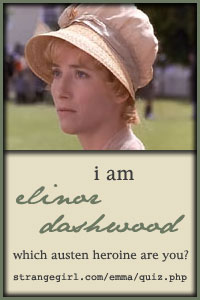
Sense and Sensibility by Jane Austen


Like so many girls, I decided to read Sense and Sensibility after reading (and loving) Pride and Prejudice.

Unfortunately, the first time I read it, Sense and Sensibility felt like a bucket of cold water.

Sense and sensibility's sad tones and tricky situations took me by surprise. And don't get me started on the male characters. Willoughby, Edward and Col. Brandon are complex and troubled - not your average romantic-comedy hero as well.

But after a second reading I began appreciating the book more. You just can't go into it expecting a light hearted commedy. For that, go to Emma.

The title relates to the two main sisters, Marianne and Elinor, who have quite opposite dispositions. Marianne is extremely sentimental and romantic while Elinor is more rational and introspective.

Both of them will have to struggle to find love and happiness. 

Something unique about Sense and Sensibility is how well the characters are constructed. Notice how we don’t actually hate the antagonists.  I, for one, felt sympathy towards Lucy, Elinor’s rival. Lucy seems to be just like Elinor: a girl trying to figure out how she can successfully marry the love of her life.


The characters have this perfect mixture of flaw and virtue. At every scene we wonder who's being smart, Elinor or Marianne. Many times we can't help but to understand them and be on their sides, even when they sabotage themselves.

This is probably what makes the novel less entertaining, but also more complex and demanding.than Pride and Prejudice

Every Jane Austen novel is a lesson in relationships. But be prepared for a difficult lesson with Sense and Sensibility. In theory, we should balance both sides (sense and sensibility). Now, If the ending backs this up, if the ending is really a happy one, is up to the reader to decide.*

What do you think about Sense and Sensibility? How does it compare to other Jane Austen novels?

Images from FanPop. These are from a great movie adaptation with Emma Thompson and a young Kate Winslet. I recommend reading the book first before watching it, though. The movie focuses too much on the two sisters and doesn’t develop the motives of Col. Brandon, for instance, and even redeems Edward’s faults.

* You didn't ask me, but I'll tell you anyhow: I'm not sure how happy the ending is. But then again I hate that Willoughby. Every time I read his name I hear “will it be?”. Perhaps I'm a little Sensibility myself.

(This is the 3rd book in my Classics Club Challenge. Click here for the full list with the other books in this challenge, plus their reviews.)

February 20, 2013

Larger than life: Franz Roubaud's war panoramas


Assault on Gimry by Franz Roubaud, 1904. (source)

Did you know I almost studied History in college?

Here’s why I didn't:

The other day I was on Wikipedia researching about the Crimean War. The minute the page opened my eyes were drawn to the painting that was illustrating the article. After half an hour, I knew a lot about that painting and nothing about the Crimean War.

So, you see I made the right choice.


                        detail of The Battle of Sevatopol by Franz Roubaud, 1904. (source) - full panorama here

The painting, called The Battle of Sevastopol, was made by Franz Roubaud, a 19th century Russian painter. Roubaud specialized in historical battle scenes. 

Make that: huge historical scenes.

His panoramas were so big that special pavilions had to be built just to exhibit them.

Despite what Wikipedia says, I don't think Roubaud is famous at all (has anyone ever heard of him?), at least  not outside Russia. 


Who is fighting whom by Franz Roubaud (source)

Whenever I think of big war paintings I immediately think of Picasso’s Guernica, which is little (and ugly) in comparison to Roubaud's panoramas.

The Battle of Sevatopol measures 115 meters in circumference and 14 meters in height (Guernica measures 349 cm by 776cm).

But it's not just the size. Roubaud managed to put so much attention to detail that, despite its big size, the painting is still very realistic. Not to mention everything he painted seemed action packed.

The fate of his The Battle of Sevastopol is just as warlike and tragic as the battle it depicted. 

According to Roubaud's website, during World War II "a German bomb set fire to Roubaud’s painting. Rescue workers cut up parts of the canvas and saved them. The saved fragments had unfortunately suffered to such an extent that 17 Moscow painters were commissioned to recreate the panorama after Roubaud. Today the original fragments are kept in storage."


                                                             Storming of aul Achulgo by Franz Roubaud, 1888 (source)

Can you imagine entering a burning building to save a painting? Or even cutting a painting to pieces to save it from destruction?

The thought of that breaks my heart, so I'll end with something more positive and exciting: Antiques Roadshow.

One lucky lady had a painting by Franz Roubaud in her house. After all you read so far, you can tell she's in for a nice surprise.


I wouldn't mind having one of those lying around my house.

What do you think of Roubaud's panoramas? Do you like his realistic battle scenes or prefer Picasso's symbolic Guernica?

February 13, 2013

The new counter-culture: Babette's Feast


Maybe it’s a little soon to say this, but Babette’s Feast is the best movie I’ve seen this year.

I don’t want to over sell it, but there’s a reason most people never heard of this movie.

It’s a Danish film with little action and a powerful message that goes directly against everything modern man believes and pursues.

And yet… the photography is stunning, the dialogues are moving and certain scenes are amazingly simple and philosophical. The characters are role models who would put George Bailey to shame.

Actually, Babette’s Feast seems to pick up where It’s a wonderful life left off. Both deal with the beauty (and the dullness) of everyday, ordinary life but whereas George Bailey constantly sacrifices himself for his family, the three main characters in Babette’s Feast sacrifice themselves for God and their fellow human beings.

Babette is a French refugee who lives with two elderly women, Filippa and Martine, in a small Scandinavian town. The three live very simple, humble lives: Babette working as a maid/cook and the two women helping the elderly, the poor and the sick of the village.

Problems arise when Babette, a Catholic, offers to make a typical French dinner in celebration of the birthday of Martine and Filippa’s father. The two sisters, strict Protestants, view the French dinner with utter horror and an occasion for sin and vice. Will they be charitable and allow Babette to go on with her luxurious French dinner?

The background stories of the two sisters are very interesting and their attitudes towards the pursuit of marriage and carrier are shocking to modern eyes. 

It is noteworthy that it was said that they live “impoverished lives". For our Age, where the pursuit of all interests other than our own has been dismissed, yes, their lives are boring. But for the characters themselves and those who share their Christian worldview, they live very rich lives.

I won’t say more about the story because I don’t want to spoil the movie’s beautiful surprises, but watching this movie now is just so refreshing.


The last time I went to the movies I saw 5 trailers that dealt, one way or another, with the destruction of the world as we know it. 

Five.

These movies, with fitting names such as After Earth, Oblivion, Escape from Planet Earth (can you guess which one is a children's movie?) had a lot in common. All portrayed more or less apocalyptic scenarios where Earth or part of it is destroyed and people are left alone to fight for survival, their futures bleak and not promising.

Funny how these movies are far from the reality of (relative) peace and prosperity in the Western world. So, where does this need to watch bleakness and despair come from? What is it mirroring? Since it doesn’t mirror the outward reality, it must be expressing our inner reality. 

The question is: do these movies offer a sense of meaning or belonging in the end? Or are they fueling our dissatisfaction with violence and destruction, deepening an inner void?

Think of The Hunger Games. The main character offers to die for others, which is a much bigger and courageous sacrifice than the ones in Babette’s Feast or It’s a Wonderful life. But the presence of action, violence and competition in the movie end up glamorizing this sacrifice.

What Babette, Martina, Fillipa (and George Bailey) do is not glamorous at all. 


But what is more readily available: to give away your life or to eat a coarse, unseasoned soup without complaining like Babette does?

Babette’s Feast reminds us that our lives, no matter how much they are filled with seemingly ordinary, repetitive actions, can be very meaningful and rich. 

That's something we easily forget, specially with so many movies teaching us otherwise. Which is why I wish more people would watch and learn to appreciate Babette’s Feast.

I’d say that very soon, movies like this and It’s a wonderful life will be considered outdated. I consider them counter-culture.

Have you seen Babette's Feast or It's a Wonderful Life? What do you think of these new movie releases?

Images: 1, 2 (Dvd still), 3